By Dr Tom Quilty, BVSc | Vet on the Road — Mobile Equine Service across the Central Coast NSW
This article is general in nature and is not a substitute for veterinary advice. Every animal is different — always consult your veterinarian for diagnosis and treatment specific to your pet.
A horse vet on the Central Coast provides annual physical exams, core vaccinations (tetanus, strangles, Hendra), dental assessments, parasite management, lameness investigations, colic response, and skin condition treatment. Mobile horse vets like Vet on the Road carry out all of this on your property, removing the need to load horses onto a float.
Introduction
If you’re searching for a horse vet on the Central Coast, you’ll know that finding a vet who genuinely understands horses in this region isn’t always straightforward. This guide pulls together everything a Central Coast horse owner needs to know about keeping their horses healthy across a year: the basics every horse genuinely needs, the conditions that come up most often on local properties, what the vaccinations situation actually looks like in NSW, and what changes when your vet comes to the paddock instead of the other way around.
Dr Tom Quilty has spent over ten years in mixed practice — five at a busy Central Coast hospital, then five as primary veterinarian at one of Australia’s most remote clinics in the Pilbara. (For a separate breakdown of how to choose the right horse vet for your property, see our Trusted Horse Veterinarian on the Central Coast article.)
- Introduction
- What Should a Horse's Annual Care Include?
- What Are the Most Common Health Conditions in Central Coast Horses?
- When Should You Call a Horse Vet?
- What Vaccinations Does My Horse Actually Need on the Central Coast?
- How Should I Manage Parasites in My Horse?
- Why Does a Mobile Horse Vet Work Better for Central Coast Properties?
- How Do I Book a Mobile Horse Vet on the Central Coast?
- Frequently Asked Questions About Horse Vets on the Central Coast
- Meet the Team at Vet on the Road
What Should a Horse’s Annual Care Include?
The non-negotiable annual care for any Central Coast horse is a physical exam, core vaccinations (tetanus, Hendra, and strangles where relevant), parasite management, a dental assessment, and a nutrition review.
Every horse on the Central Coast — regardless of age, breed, or job — needs the same set of core items each year. Translated into a practical list:
- Full physical examination — heart, lungs, gut sounds, body condition score, eyes, skin, posture, conformation check.
- Dental assessment — far more important than most owners realise.
- Core vaccinations — tetanus is the absolute baseline; Hendra strongly recommended; strangles risk-based.
- Parasite management — based on testing and evidence rather than guesswork.
- Nutrition review — what your horse eats versus what your horse actually needs.
For senior horses or those with ongoing health conditions, two checks a year is the better standard. Older horses develop dental, weight, and metabolic problems quietly, and a six-month gap between visits gives those issues a much shorter runway.
What Are the Most Common Health Conditions in Central Coast Horses?
The most common conditions seen on Central Coast properties are dental disease, summer itch, hoof abscesses from wet pastures, and nutrition problems — with colic and lameness rounding out the list every equine vet sees regularly.
The Central Coast’s combination of warm weather, wet seasons, coastal humidity, and pasture types produces some predictable patterns. After a decade of mixed practice, Dr Tom’s shortlist of what comes up most often on local properties starts with three things owners frequently miss or bring in too late: dental disease, summer itch, and nutrition problems. Add wet-pasture hoof abscesses to the list — a constant on Central Coast properties through the wetter months — and you have most of what a local equine vet sees in any given week.
The four conditions below are the ones every Central Coast horse owner should be able to recognise in the early stages.
Colic — the most feared horse emergency
Colic is a broad term covering any abdominal pain in a horse, from mild gas discomfort to life-threatening intestinal displacement. It’s one of the most common reasons horse owners call a vet, and one of the few situations where the speed of your response can genuinely change the outcome.
Early signs include pawing at the ground, looking at or biting the flank, lying down and getting up repeatedly, restlessness, mild sweating, and a noticeable drop in droppings or appetite. More severe signs include violent rolling, rapid breathing, and pale or tacky gums.
Any colic that doesn’t resolve quickly is an emergency. Don’t wait it out, don’t try home remedies, and don’t administer anything without veterinary instruction. For the full breakdown — early signs, what to do while you wait for the vet, and how to reduce colic risk on your property — see our dedicated Colic in Horses: Signs, First Aid & When to Call Your Vet article (publishing next month).
Dental disease and the need for floating
Ask Dr Tom what the single biggest gap in Central Coast equine care looks like, and the answer is dental disease. Horses don’t show pain in their mouths the way dogs or humans do — by the time the obvious signs appear, things are usually already bad. Quidding (dropping half-chewed feed), unexplained weight loss, head tossing under the bridle, or visible asymmetry in chewing are late signals. The horse has often been in low-grade pain for months by the time an owner spots them.
Horse teeth grow continuously throughout life, and uneven wear creates sharp enamel points that injure the cheeks and tongue. But — as Dr Tom regularly points out to owners — simply rasping those points down isn’t the be-all and end-all of horse dental work. Decay, fractures, retained baby teeth, malocclusions, and gum disease can all develop quietly underneath an apparently fine-looking mouth.
For the full picture on what dental floating involves, how often it’s needed, and what owners can spot at home, see our upcoming Horse Dental Floating: What It Is and Why It Matters article.
Lameness
Lameness is the most common cause of lost performance in horses — and one of the most under-investigated. In the early stages it can be subtle: a slight reluctance to pick up a particular lead, stiffness on cold mornings that warms out, a mild head bob that only shows on hard ground.
A proper lameness examination involves observation in walk and trot on different surfaces, flexion tests, hoof tester examination, and — where appropriate — diagnostic local anaesthetic blocks. Dr Tom conducts full lameness assessments on-site. The advantage of doing this on the property is significant: the horse moves on its normal surfaces, around its normal mates, on the ground it actually lives on.
Field assessment will identify the cause in many cases. Where imaging is needed to diagnose precisely, you’ll be referred to a hospital with the right equipment and walked through what to expect.
Queensland itch (Summer itch)
Despite the name, Queensland itch is extremely common across the Central Coast — particularly in coastal and semi-rural areas where Culicoides midges breed in damp ground. It’s an allergic dermatitis triggered by midge bites, and once a horse develops it, the cycle tends to worsen each summer.
Signs to watch for from late spring onwards:
- Intense itching, especially along the mane, tail base, and belly
- Hair loss in patches and broken-off mane and tail hairs
- Thickened, leathery skin where the horse has rubbed repeatedly
- Open sores from constant rubbing on fence posts and trees
Management is about prevention rather than cure. Insect rugs, application of insect repellent, and stabling at dawn and dusk during midge season all help. Treating any secondary skin infections early matters too — broken skin invites bacterial complications that compound the itch.
If your horse rubbed itself raw last summer, the time to set up a management plan is before this summer starts.
When Should You Call a Horse Vet?
Any signs of colic, severe lameness, foaling difficulty, choke, or neurological signs warrant an immediate call. Annual vaccinations, dental checks, and routine parasite reviews can be booked in advance.
Some calls are routine and can be booked in advance. Others can’t wait. Knowing the difference is one of the most useful things a horse owner can carry around in their head.
Call your vet immediately for:
- Any signs of colic — pawing, flank-biting, rolling, restlessness, sweating
- Severe lameness, especially with heat, swelling, or refusal to weight-bear
- Wounds that are bleeding heavily, near a joint, or visibly contaminated
- A horse that is down and won’t get up
- Foaling difficulties of any kind
- A horse showing neurological signs — wobbliness, head pressing, seizures (these can indicate serious conditions including Hendra)
- Choke (food stuck in the oesophagus) — visible distress, salivating, coughing
- Eye injuries — these deteriorate rapidly without treatment
Book a routine visit for:
- Annual health checks and vaccinations
- Routine dental floating (yearly for most horses)
- Faecal egg count and parasite review
- Mild lameness investigation
- Skin conditions including suspected sweet itch
- Nutrition and body condition review
- Pre-purchase examinations
- Foal and weanling checks
If you’re not sure which category a situation falls into, the answer is always to call. The downside of a phone call you didn’t strictly need is small. The downside of waiting too long with a serious case can be enormous.
What Vaccinations Does My Horse Actually Need on the Central Coast?
On the Central Coast, tetanus is non-negotiable, Hendra is strongly recommended, and strangles is risk-based depending on whether your horse mixes with other horses regularly.
There’s no national legislated vaccination schedule for horses in Australia, which leaves a lot of owners genuinely unsure about what’s truly essential versus what’s optional. Here’s the practical answer for Central Coast horses.
Tetanus — non-negotiable. Tetanus is universally fatal in unvaccinated horses, the bacteria are everywhere in soil, and the vaccine is cheap, safe, and effective. Annual boosters are the standard, with an additional dose at the time of any injury or surgery in horses whose status is uncertain.
Hendra virus — strongly recommended. Hendra is a zoonotic virus carried by flying foxes that can be transmitted from horses to humans, and it has been fatal in both. NSW falls within the risk zone, and the NSW Department of Primary Industries provides current information on Hendra virus risk and vaccination. Hendra vaccination is not legislated as compulsory for all horses in NSW, but it is highly recommended — Hendra is a deadly disease that can be prevented by a simple vaccination, and a vaccinated horse also has access to a wider pool of equine vets, as some will only treat vaccinated horses. Vet on the Road will see both vaccinated and unvaccinated horses, but strongly recommends vaccination for the safety of the horse, the vet, and everyone on the property.
For everything an owner needs to know about Hendra — how the vaccination course actually works, local risk, and what happens if your horse is unvaccinated and needs emergency care — see our upcoming Hendra Virus in Horses: What Every NSW Horse Owner Must Know article.
Strangles — risk-based. If your horse goes to shows, agistment, or is regularly in contact with new horses, strangles vaccination makes sense. If the horse lives at home with the same paddock-mates year after year, the risk is much lower. Worth a conversation rather than an automatic yes or no.
How Should I Manage Parasites in My Horse?
Modern parasite management means strategic worming based on faecal egg counts rather than blanket drenching every two months, combined with sensible paddock management and external parasite control.
For decades, the standard advice was straightforward: drench every horse, every two months, every year. That advice is now genuinely out of date — and continuing to follow it is one of the reasons drench resistance is becoming a serious problem in Australian horse populations. The 2025 Australian Guidelines for Equine Internal Parasite Management — published in the Australian Veterinary Journal by the Australian Equine Parasitology Advisory Panel — set out the current evidence-based approach, which aligns with what Vet on the Road recommends.
The current best practice is strategic worming based on faecal egg counts. The process is simple:
- A small fresh manure sample is collected from each horse.
- The sample is examined under microscope to count parasite eggs and identify species.
- Treatment is targeted only at horses whose burden warrants it, and with the drench class that’s actually appropriate for what’s there.
The benefits stack up. Resistance slows. Cost goes down — a horse that doesn’t need worming doesn’t get wormed. And the picture you build over time — which paddocks have problems, which horses are consistently low-burden, which seasons matter — informs better property-level decisions.
External parasites matter too: ticks, lice, and biting flies all reduce coat quality and welfare, and on Central Coast properties the wet pasture and shaded gullies create perfect conditions for them. A proper parasite management program looks at all of it together — internal, external, paddock rotation, manure management — rather than reaching for a tube of paste every eight weeks.
Why Does a Mobile Horse Vet Work Better for Central Coast Properties?
A mobile horse vet sees the pasture, the environment, and the horse on its home ground — information a clinic vet can’t access — while removing the cost, stress, and logistics of floating horses to a hospital.
There’s a practical reason most Central Coast horse owners gravitate toward a mobile equine service once they’ve experienced one: it works better, for the owner and for the horse.
No float required. For owners with one or two horses and a working float, that’s a convenience. For owners with multiple horses, geriatric horses, anxious travellers, or no float at all, it’s the difference between getting care done and not getting care done.
The vet sees more. On every property visit, the assessment starts before Dr Tom has touched the horse. From the moment he pulls in, he’s reading the pasture and the environment — pasture type, ground condition, evidence of high ground for wet weather, sources of feed and water — and forming an initial picture of the horse’s body condition, conformation, and demeanour. Some grasses cause disease processes in horses. Some weeds do too. The wet patches and high ground tell him whether hoof abscesses are likely. None of that information exists in a clinic environment.
One visit covers more ground. The travel fee is charged once per visit regardless of how many horses are seen — and on a mixed property, the same visit can also cover the dogs, cats, and livestock. (For mixed-property owners, our upcoming Farm & Hobby Farm Animal Vet article covers how a single visit can handle small animals, livestock, and equine all together.)
What happens during a typical mobile horse vet visit?
For owners who haven’t used a mobile equine service before, here’s roughly how a routine annual visit unfolds:
- Arrival and property scan — pasture, ground conditions, paddock setup.
- Visual horse assessment — body condition, posture, demeanour, before any handling.
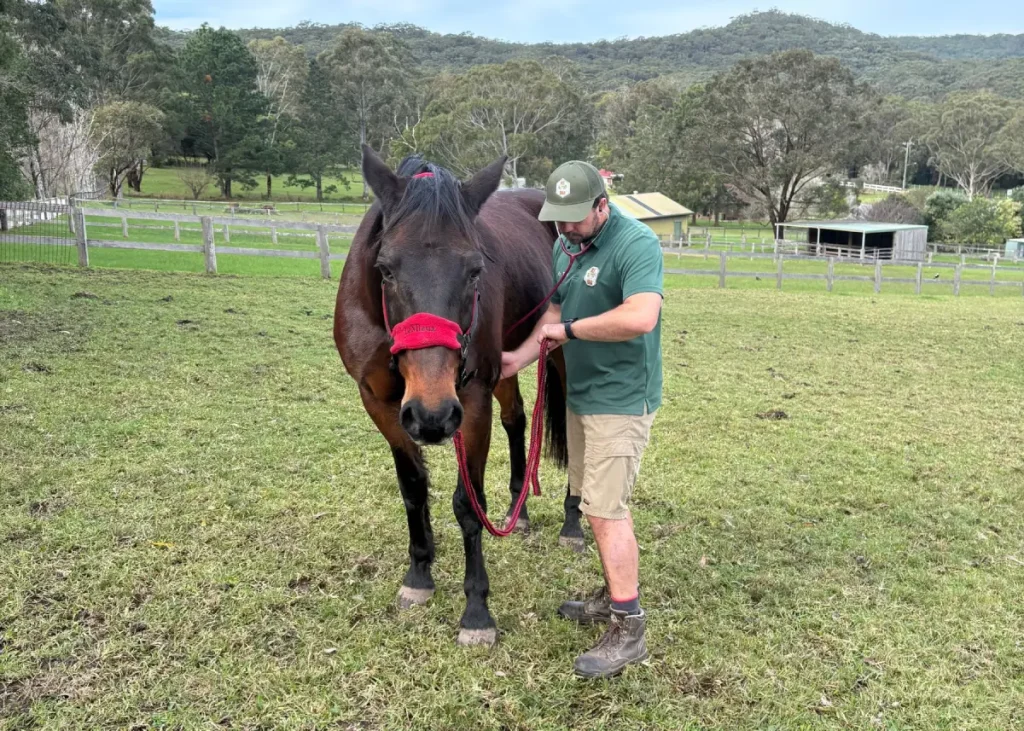
- Hands-on physical exam — heart, lungs, gut sounds, skin, eyes, teeth.
- Dental assessment and floating if needed (within field-procedure scope).
- Vaccinations administered — tetanus, Hendra booster, strangles where appropriate.
- Faecal sample collected for egg counts; parasite plan adjusted based on results.
- Discussion — what’s working, what’s not, anything you’ve noticed. Records updated for next visit.
Most routine visits take 45–90 minutes per horse depending on what’s being done.
How Do I Book a Mobile Horse Vet on the Central Coast?
Book a visit online through our Contact page or call or text 0490 877 553 — same-day response Mon–Fri, 8am–4pm.
Booking with Vet on the Road is straightforward.
- Book online — the quickest way is to submit a visit request through our Contact page. Same-day response during business hours.
- Or call or text 0490 877 553 — Mon–Fri, 8am–4pm.
- Tell us the basics — your property location, the number of horses, and the reason for the visit. For first-time clients, a quick rundown of each horse’s history is helpful: vaccination records, age, any ongoing conditions.
Service area covers the full Central Coast — Gosford, Erina, Wyong, Terrigal, Avoca, The Entrance, Toukley, Woy Woy — plus the rural valleys: Dooralong, Yarramalong, Jilliby, Kulnura, Mangrove Mountain, and surrounds.
For a clear breakdown of consultation costs, see our Pricing page.
Frequently Asked Questions About Horse Vets on the Central Coast
Meet the Team at Vet on the Road
Vet on the Road is an independent mobile veterinary practice serving horse owners and pet owners across the full Central Coast, including the rural valleys of Dooralong, Yarramalong, Jilliby, Kulnura, and Mangrove Mountain.
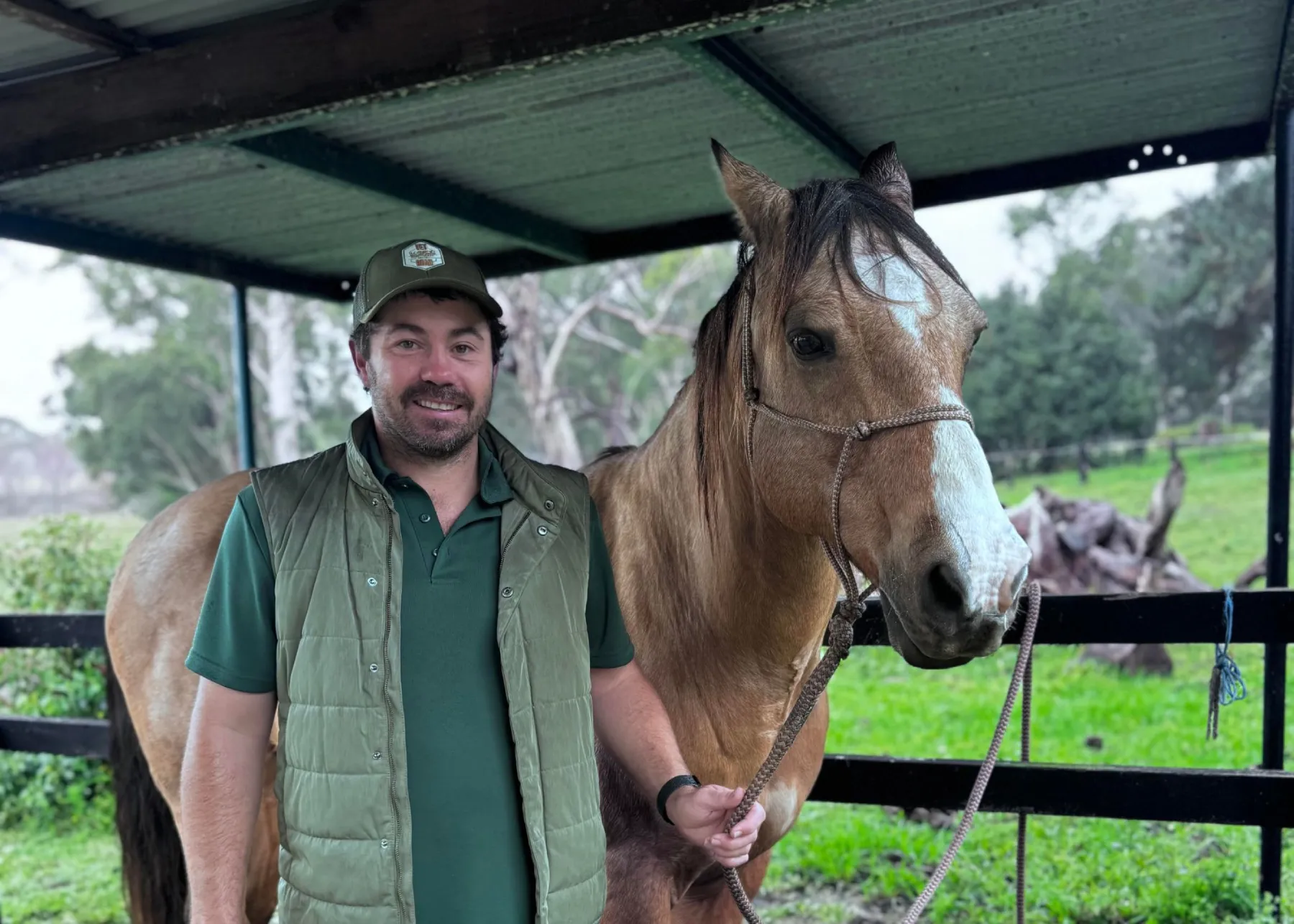
Dr Tom Quilty brings over ten years of mixed practice experience to your paddock — including five years as primary veterinarian at one of Australia’s most remote clinics in the Pilbara. New clients are always welcome to phone or text with questions before booking, and the team is happy to talk through anything from a first equine visit to a second opinion.
Phone or text: 0490 877 553
Hours: Monday–Friday, 8am–4pm
Service area: Central Coast NSW